
Table of Contents
- Why managers need practical AI literacy
- Who this training suits
- What a management-focused AI course should teach
- Tools and business functions
- Practical projects and assessment
- Innova’s one-year programme
- Career and workplace applications
- How to compare courses
- Frequently asked questions
Why managers need practical AI literacy
AI affects project planning, operations, procurement, logistics, research, reporting, customer communication and risk management. A manager who understands these systems can identify worthwhile use cases, ask better questions of technical teams and prevent automation from being introduced without governance.
The aim is not to replace leadership with software. Managers still define objectives, allocate resources, resolve trade-offs and remain accountable for outcomes. AI can accelerate research, highlight patterns and perform repetitive steps, but people must interpret the result and make the decision.

Who this training suits
Management-focused AI training is relevant to project managers, operations professionals, team leaders, entrepreneurs, business analysts and graduates preparing for coordination or leadership roles. It can also suit non-technical managers who are comfortable with everyday business software and want a structured route into automation.
The original Innova articles repeatedly emphasise that coding is not the starting requirement. The more important foundations are process thinking, analytical judgement, digital confidence and willingness to work through real scenarios.
What a management-focused AI course should teach
The curriculum should connect business planning with implementation. Learners need to map a current process, find delays and repetitive steps, define the desired result, select tools, identify data requirements and set measures of success.
Core areas can include project planning and control, procurement and contracts, risk management, logistics, operations and information management, research methods and a cross-functional business project. Responsible programmes also cover data quality, access control, privacy, human review and change management.
Tools and business functions
Innova’s current course page lists n8n, Asana, Airtable, Trello, Slack API, Tableau, Power BI, Google Workspace, APIs, webhooks and CRM tools. Earlier programme content also referenced Microsoft Project, SAP S/4HANA, IBM Watson and Salesforce Einstein. Tool availability can change, so applicants should ask which platforms are currently taught and which are examples used within a wider concept.
In project management, tools can support task routing, reminders, status collection and reporting. In procurement, automation can coordinate vendor data, approvals, inventory and risk alerts. In logistics, it can support route planning, maintenance scheduling and operational dashboards. In finance and compliance, it can assist research, reporting, KYC workflows and AML alerts, provided the process includes appropriate review.
Practical projects and assessment
Tool knowledge becomes valuable when learners can combine systems. A meaningful project might capture a request through a form, validate the information, route an approval, update a database, notify a team and create a dashboard. The learner should also document exceptions, permissions and points where a person must intervene.
The supplied one-year brochure describes weekly quizzes, practical assignments, participation and a final international business project. Its structure allocates study to planning, management tools, procurement, risk and contracts, project and logistics management, operations, information management, advanced research and a hands-on final project.
Innova’s one-year programme
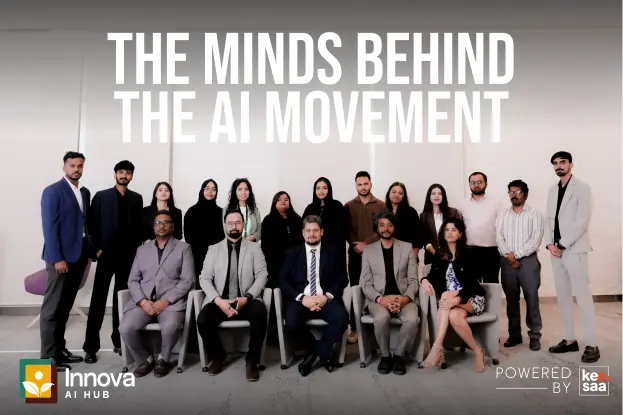
Innova’s Advanced Course in AI Automation for Managers and Business Leaders is currently presented as a one-year, face-to-face programme with two sessions per week. The supplied brochure describes a limited group of five to eight participants. The live page lists high school or three years of professional experience as an entry route, along with comfort using basic business tools and strong analytical thinking.
The stated objectives include mastery of AI tools for project management, advanced planning, logistics and operations, strategic procurement and risk management, and data-driven decision-making. The live page describes KHDA and IOA accreditation and Qualifi endorsement. These details should be verified for the intended intake before publication or enrolment.
Career and workplace applications
The programme can support work in automation strategy, project leadership, business operations, procurement and logistics. Original articles also identify strategic consulting, analysis and operations leadership as possible directions. The strongest career evidence is a portfolio of well-documented systems, not a broad title claim.
For a working manager, value may appear before a role change. A useful automation can reduce manual handoffs, improve reporting, shorten response time or make an approval process easier to audit. Participants should select projects connected to their actual function whenever possible.
How to compare courses
Compare course duration, live practice, tool access, trainer background, class size, assessment and the complexity of the final project. Ask whether the course teaches isolated prompts or complete workflows. Confirm whether examples cover your function and whether light scripting is required for advanced integrations.
Also request current details for schedule, fees, scholarship or group discounts, certification and career guidance. If an institute promotes interview opportunities, internships or placement support, obtain the written eligibility criteria.
Frequently Asked Questions
Can a non-technical manager learn AI automation?
Yes. No-code and low-code platforms make many workflows accessible, although advanced integrations may require technical support or light scripting.
Is an AI course for managers mainly about ChatGPT?
No. Useful programmes cover process design, data, integrations, automation, reporting, governance and implementation as well as generative AI.
What should I build during the course?
Aim for an end-to-end workflow connected to a real business problem, with clear inputs, approvals, outputs, exception handling and success measures.
How long is Innova’s manager programme?
The current course material describes a one-year face-to-face format with two sessions per week.
Ready to lead a practical automation initiative? Review the current curriculum and speak with Innova about the tool track that best matches your function.